Thoughts on Audience Segmentation Via Clayton Christensen’s Theories

In the past, I’ve written about the line that exists between audience segmentation versus fragmentation. In it, I pondered whether our institution’s landscape of nearly 300 social media accounts constituted good segmentation or out-of-control fragmentation. Since that June 2011 post, I’ve been doing a deep dive into Clayton Christensen’s work. He discusses how well intentioned, smart people can wind up with erroneous conclusions and poor results through the use of traditional audience segmentation practices (i.e. demographics) when it comes to innovation. Why? Because it typically only leads to incremental advances, squeezing out a bit more success where small pockets of opportunity might still be found. To make leapfrog advances, however, requires a different approach. Christensen’s work deals with disruptive innovation, but I believe aspects of his work can readily be applied to marketing in the higher ed world. One of his main ideas goes something like this: it’s a customer’s circumstances that should drive your efforts, not the actual customers themselves. You should ask yourself the question “What job is the customer hiring this product/service to do for them?” rather than “How can we use the data we know about the customer to entice them to use this product/service.”

In higher ed, we ask the latter question based on the segments we all know well: prospects, students, alumni, donors, parents, faculty, etc. The problem with this approach is that it’s too far removed from what our audiences need to get done. We segment this way based on what we want them to do, not necessarily by what they need to do. The gap that exists between the two is where you’ll find ineffective marketing.

In alumni relations, for example, we work hard to get people to engage with the institution through events, social media, etc. What that approach misses, however, is the fact that many of our alums don’t want to engage with us. It’s nothing personal, they just don’t. Yet, we shower them with as much marketing and programming as we can only to find that the efforts end poorly. Additionally, some who do participate will only do so because there is a temporary alignment of goals: we offer free food at a sporting event and an alum, who planned to attend anyway, decides to “participate” in order to get the free food. We mark that down as engagement, but it isn’t- at least not in the way we intended.

Let’s now take a Christensen approach and ask “What job is a member of the university community trying to get done?” Search for a job is sure to be top of mind, but what else? How about work/life balance, support for entrepreneurial start-ups and better time management skill? Seen this way, we find that these jobs aren’t limited to what we label “alumni.” Alumni may indeed list finding a job a top priority, but so would many other traditional audience segments. We see this with any set of jobs needing to be done. Parents grapple with work/life balance, students start businesses and everyone could probably benefit from better time management. We find that our traditional methods of segmentation are too one dimensional and place people in buckets that may not reflect who those people really are. In turn, they won’t provide a good foundation for programming and marketing success. If we simplify a group like alumni that are, in reality, exceptionally diverse, we end up creating and promoting programming and marketing that are one size fits none. Everybody loses.

So why does higher ed lump people in marginally meaningful ways? It’s likely because that’s how our internal systems, organization and data are aligned. As students graduate, they are deleted from the student bucket and placed into the alumni bucket and, hopefully, handed off to the alumni relations group for further engagement. Unless your institution has a sophisticated CRM tool that actively tracks the right sorts of data, then you can’t segment based on anything more meaningful. Unless fundamental change occurs, higher ed will be unable to think about it’s audiences based on their needs rather than their superficial characteristics.

This is very similar to the user experience field which wants to be “customer focused” by addressing people’s needs and wants. Needs and wants are uncovered through research and then tested against as the experience being built is created. This same approach is analogous to what Christensen advocates. To be truly successful requires us to uncover our audiences’ needs and create programming and marketing that specifically addresses them. That will require us to avoid grouping people in our traditional ways.

If you’re interested in learning more about Christensen, here’s a great starter video that gives an overview of his theories. Highly recommended, of course.
Google Maps Frustration

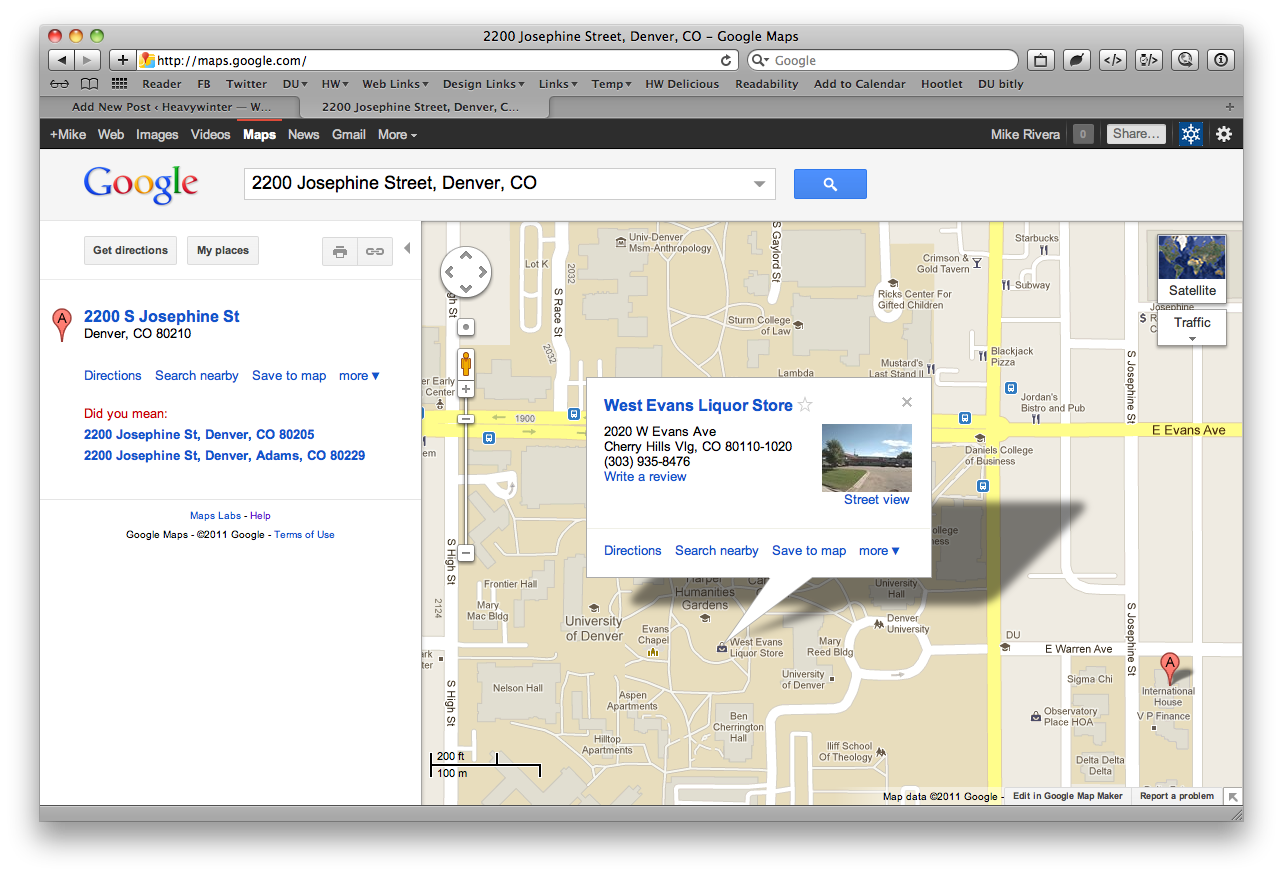
If you search for our university on Google maps you’ll find a listing for a liquor store right in the middle of campus (which isn’t correct, of course). So, what’s a person to do? Report the problem to Google, right? Right. Well, good luck. I didn’t see an obvious way to submit an issue, so I went to the help link and did a search. I ended up a Google help article describing how to report a problem. Let’s count the problems with this process, shall we?

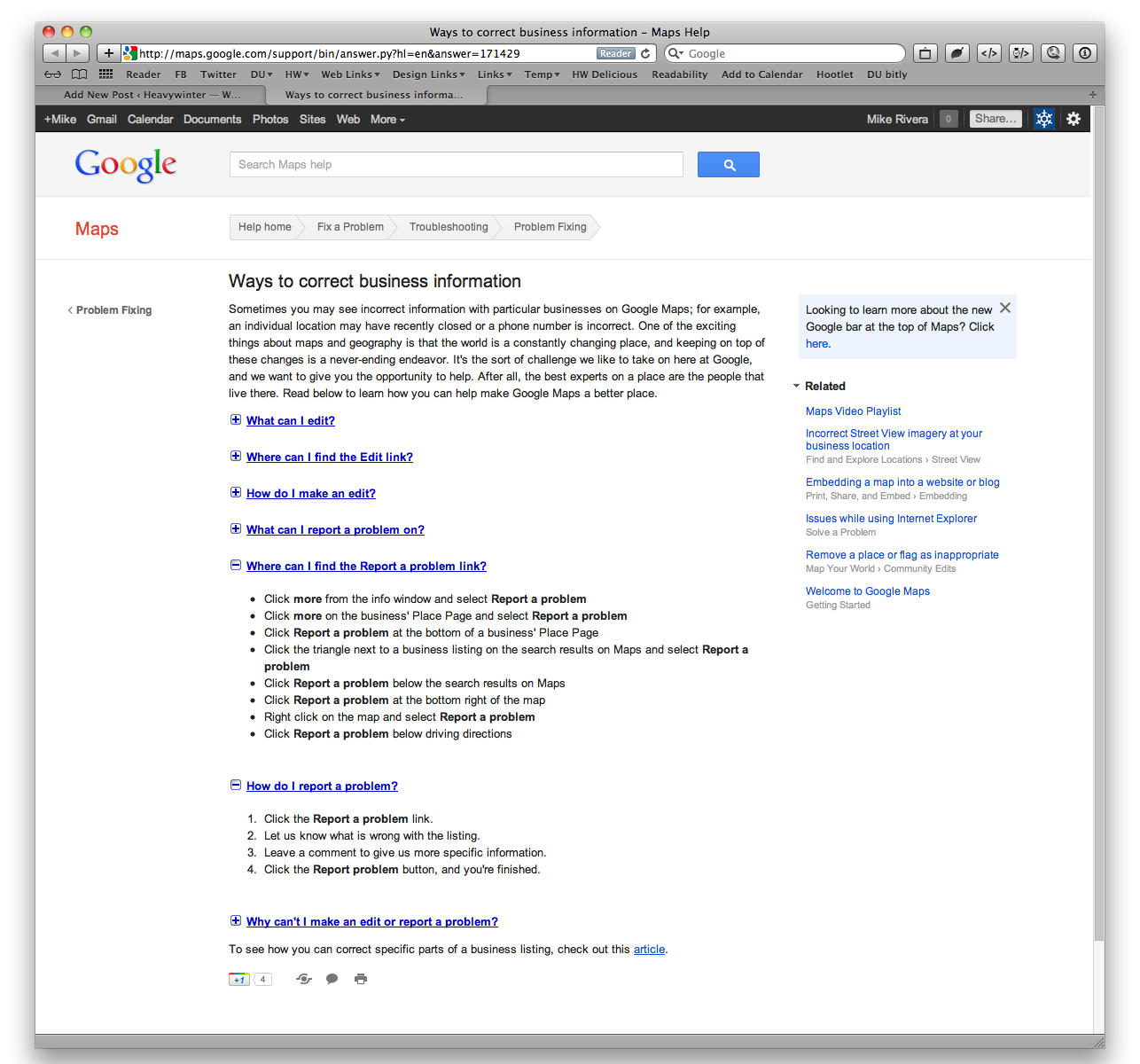
Google's report a problem help file. Google's erroneous map showing a liquor store in the middle of campus.

  1. Most obvious, is that there is no obvious way to report a problem when you’re in the maps area. It’s an outlier use case, I’ll grant you that, but still, it’s not carte blanche to hide it. The most logical place to go then is the help link.
  2. The help article has a “how do I report a problem” toggle. Perfect! This is exactly what I need. Wel,, hangon a second. It mentions a “report a problem” link, but fail to actually provide the link. They instead choose to talk about it. Hello? This is the web, right?
  3. Given the above oversight, I decide to open the “where can I find the report a problem link” toggle (which wouldn’t be necessary if they simple gave the link in question). It instructs to click “more” from the info window. What’s the window info, you ask? Who the hell knows? Figure it out for yourself.
  4. As I ponder what they might mean by info window, I see a “more” link in the top black bar- maybe that’s what they mean by the info window? Doesn’t seem like an info window, but OK, I’ll try it. Nope. That only shows all the various Google product links, no “report a problem” to be found there.
  5. OK, the info window must be within Google maps then. Ha! Silly me, of course! I should have looked in the maps area all along. User error, my bad. I go back to the problematic map and bingo, I spot the more link right there in the left sidebar, er… info window. Why is the left column called an info window? That’s not my definition of a window, nor anyone else’s I suspect, but hey, details. Why quibble now, I’m so close to successfully achieving my issue submittal.
  6. I open the “more” pulldown menu, but alas, the report a problem link is greyed out. What gives? Why show functionality when you can’t actually use it? At this point, I’m thinking to myself “Holy crap! I have got to blog about this.”
  7. My last ditch effort is to click on the offending liquor-store-in-the-middle-of-campus pop-up  to see if I can report the problem there (maybe that’s what they mean by an info window?). Indeed, the pop-up also has a more pulldown with a functioning report a problem link.
  8. The problem report asks me some questions in order to route and solve the issue, but the last bit of information they ask for is to let them know the correct market placement for the liquor store. I was nice in my reply since I’d like the problem corrected, but seriously, they want help in placing the marker correctly? How about using the address they already have listed for the store which is in a different city altogether? It boggles the mind.

The Perfect Higher Ed Layout?

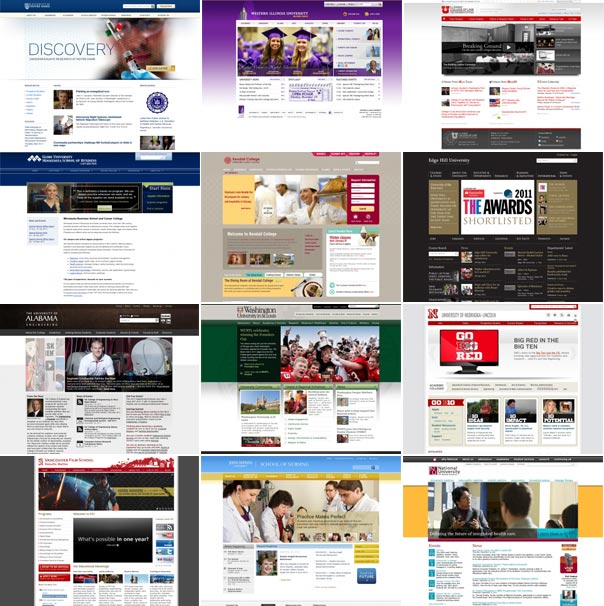
I decided to head over to eduStyle to check out all the site redesign submissions I’ve missed over the last few months. It turns out that “differentiation” doesn’t seem to be a marketing objective anymore. Check out all these variation on a theme (and there are plenty more I could have chosen). What gives? Have we as an industry actually hit upon higher ed’s perfect website layout- big image/interactive area across top with multiple columns of text and images below?

12 higher ed sites that all share the same layout.

Please Abandon Regularly Scheduled Email Newsletters

Most emails I get arrive on a regular schedule. Some monthly, some weekly, some daily. But I can only think of a handful that are mailed on an as needed basis. They send me mail when and if they have something of value to tell me. Otherwise, they get out of my way and help keep my inbox free of clutter. Brilliant!

This came up recently for me because of two things:

Part of an email sent to me that doesn't actually offer anything of value.First, I received a regularly scheduled newsletter that apparently decided to hit send even though they didn’t have content to fill out their mailing. The screenshot of the cse in point even admits they didn’t find enough good content to send, but send they still did. Now, in their defense, the email is typically full of good links, and this particular edition did too, just not in this particular section. So I wonder, why not wait on this mailing until there’s enough good content to justify hitting send?
Second, I’m in the process of thnking about e-newsletters on behalf of my university’s alumni relations group. They currently send an email on a bi-weekly basis. That’d be fine if the content in those emails supported such a constant stream. However, and it’s one man’s opinion of course, I don’t think it does. It’s chock full of stuff I don’t care about (I happen to be in their target audience so I can make that claim), is way too long, has no focus/theme/glue to what is included, and it doesn’t look appealing. So why not abandon the bi-weekly schedule and move to an as-needed basis? It’d be less work internally to create and become more valuable to recipients because it’s only sent when there’s something valuable worth sending.

When Audience Segmentation Turns Bad

I came across this series of blog posts from NYTimes columnists David Brooks. In his own words:

“…I asked readers over 70 to write autobiographical essays evaluating their own lives.”

I love that idea.

Higher ed could do take Brooks’ basic idea and fill some of the gaps that exist with prospects’ and students’ relative lack of life experience compared to alumni. Imagine if we offered the accumulated life experiences, lessons learned, career exposure and general worldliness of alums to the rest of our university’s community. It would create bonds of affinity (not to mention a deep well of outcome oriented stories) by tossing aside the artificial audience segmentations we’ve created as an industry- prospects, students, donors, faculty, alumni, parents, etc.

I see all audiences sitting on a continuum where boundaries only exist if you purposely create them. I’m an alum of the university I work for but I still feel I’m a student at heart. I know I’m not technically a student, but I identify myself as a life long learner which shares the same state of mind as a student who may be 20 years younger. So why put up a barrier between us and treat us separately? Our needs certainly differ in important ways and those needs to be accounted for, but at what expense and to what degree? I think any higher ed’s community shares more similarities than differences.

How Organizational Structure Impacts Brand

A university’s ability to communicate with students is contingent on its internal systems working efficiently and effectively. Otherwise, the institution risks communicating a disorganized message, misinformation and a confused brand. In this presentation, I walk through some organizational structure ideas as they apply to higher ed and how they affect institutional branding. From there, I talk about how structural barriers can be overcome to help dissipate some of the negative effects.

Social Media Fragmentation vs. Segmentation

Susan Talbert Evans wrote a great post about the difference between fragmentation and segmentation when it comes to social media.

My university (11-12,000 students) is about to enter into this discussion so this is a timely, well thought out piece. I work in a centralized comm department and my recent census of school related social media accounts turned up what I consider a whopping 240 Facebook, Twitter, YouTube and Flickr accounts (I haven’t canvassed for blogs yet). Our school largely operates under an anything goes policy when it comes to social media which has enabled this kind of growth.

Susan’s belief is that social media works better when accounts are allowed to grow organically. They’re apt to be more authentic and focused compared to more general and centrally controlled accounts. She lists four reasons why and I agree with her rationale. Her central point is that more accounts doesn’t necessarily equate to fragmentation to message and brand, but instead can be thought of as beneficial segmentation.

I’m all for segmentation as Susan describes it, but surely when there’s a ratio of 50 students for every social account as is the case for my institution, we’re seeing less segmentation and more fragmentation, right? Hard to tell given that I don’t have the time to do a systematic audit of what each account is saying and doing. However, I’m willing to accept that the overall number of accounts isn’t as important as whether each account is a vibrant community that provides value to the participants that exceeds the costs that go into making and maintaining the community. Again, that’s hard to measure though I’m willing to grade leniently on the value vs. cost comparison.

That leaves me in a position of experimentation. Our school has hundreds of outposts across third party networks which is great (go where the people are, right?). But with so many options, how does one know where to find the right community- or communities- to join? How do we ensure people aren’t being sent the same messages over and over again across different accounts (and is that even perceived as a problem by our audiences?)? These sorts of questions beg for centralized coordination which, in turn, may suggest centralized systems, processes and management. Too bureaucratic for internal staff? Maybe, probably. No one likes change nor big brother looking over their shoulder no matter how benevolent that oversight might be. But its a discussion worth having and will be one of the core concepts that our school discusses as we dive into the topic.

Research will surely bring light and objectivity to the discussion and it will take place, but for now, my belief (as always to anyone who reads this blog) is that operations should be centralized while content creation should be decentralized. To me, that strikes a balance between being too bogged down in red tape and the brand being too easily diluted. More to come on this topic…

To Centralize or Not to Centralize… That is the Question

McKinsey Quarterly takes a look at the centralize vs. decentralize decision so many organizations face and one, in my humble opinion, which higher ed should ask more often. McKinsey recommends asking three questions to frame productive debates on the subject. From the article:

Is centralization mandated? Can it add 10 percent to a corporation’s value? Can it be implemented without negative side effects? A proposal to centralize only needs a yes to one of these three questions. Yet they provide a high hurdle that helps managers avoid too much centralization. Moreover, they stimulate open and rational debate in this highly politicized area. By giving those in favor of centralization and those opposed to it a level playing field for building a case, these questions help companies strike the right balance between centralization and decentralization today and to evolve their organizations successfully as conditions change over time.

Achieve Your Strategy Through Influence

One step you can take to help achieve your communication strategies is to leverage influencers on the web. You can use tools like the ones below to help determine and judge who are good targets. Once identified, take the time to get to know each influencer and the world that swirls around them: how often do they post, what’s their angle and bias, what’s the tone of the overall conversation, how are you networked to them (if at all), etc.

So many people on the web and social media channels simply listen in on the chatter and leave lots of opportunities on the table. Your next step is to join the conversation and participate. You have thoughts, opinions and expertise to share (really!) so share them. As long as you provide good, relevant content, you’ll find that all the people who were merely listeners like yourself shift. Awareness of you grows and if your contributions are good, they begin to take notice of what you say, what you link to and who you’re with. In short, people begin to take you and your ideas seriously. This raises your credibility and standing within the circles you participate in and a snowball effect takes shape. You slowly accrue enough people and attention to become a nexus of conversation, people push your content out and seek your thoughts and ideas out. You’ve become an influencer yourself and the more you participate and the better the value you bring to the table, the more virtuous the cycle becomes.

Of course, this takes time and effort. You have to research, dig deep and stay focused. This isn’t fly by night work. Stick to your strategy. Leverage the influencers you find to help determine how to differentiate your contributions for your own benefit as well as those of the other participants. Shape your offerings to meet your strategic goals AND fit the needs, wants and context of the wider audience and market.